


Veri*factu
Veri*factu is the term that refers to the requirements that Information Billing Systems (Sistemas Informáticos de Facturación (SIF)) must meet, in our case, the Point of Sale Terminal (POS).
Veri*factu's priority is to secure the keys in the company's or self-employed individual's billing records:
- Sequential recording of each system transaction and event (logs).
- Generation of a unique cryptographic digital fingerprint ('hash') for each record.
- Linking of records using the hash, creating a chain that prevents the deletion or insertion of invoices.
- Inclusion of a QR code on invoices, allowing for quick verification of basic data.
- Technical capacity to electronically submit records to the Spanish Tax Agency (AEAT).
How Veri*factu Works
The process of sending invoices with Veri*factu is almost entirely automatic and is carried out through certified invoicing software adapted to Veri*factu. It works as follows:
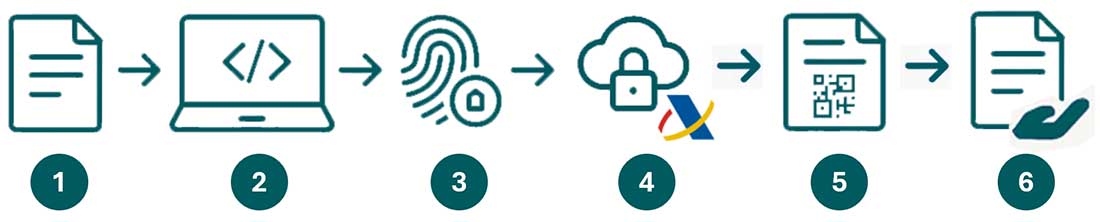
- Invoice generation: The invoice for the customer is created from the billing program (POS or management software).
- Automatic record creation: When the invoice is generated in the software, a billing record is created. This record is not the invoice itself, but a computer file (in XML format) with the essential data of the transaction.
- Signature and "Digital Fingerprint": The system applies a hash (digital fingerprint) to the record, linking it to the previous record, thus creating a 'blockchain' that guarantees the integrity and immutability of the data. No one can modify an issued invoice without breaking this chain.
- Submission to the Spanish Tax Agency (AEAT): The SIF or POS connects to the Tax Agency immediately, securely, and sends the record. The AEAT receives, validates, and stores it, also securely.
- Incorporation of a QR Code: The software generates a QR code and embeds it in the PDF of the final invoice or receipt issued by the POS.
- Sending the invoice to the customer. This QR code allows the customer (and the Spanish Tax Agency) to verify that the invoice has been declared correctly.
The Veri*factu system is the technical basis of modern fiscal control and prepares the ground for the implementation of B2B (Business To Business) or inter-company electronic invoicing.
| It affects the vast majority of economic actors in Spain who issue invoices. |
Implications of the Mandatory Compliance
- Prohibition of using office software (Word, Excel, etc.) to generate invoices, as they do not guarantee tamper-proof status.
- Certified Software or POS System: It is mandatory to use software that complies with the regulations. Your provider must give you a "Declaration of Responsibility" certifying this.
- Each simplified invoice (receipt) issued must have a standardized QR code printed on it.
- Tamper-proof Status: In the event of an error on an invoice, the only way to correct it is by issuing a corrective invoice, a process that your software must facilitate.
- Digital Storage: You must ensure the preservation of electronic invoicing records for the legally required period (backups).
Entities and professionals affected by the Veri*factu standard of the Spanish Tax Agency.
- Businesses and professionals subject to Corporation Tax (Impuesto de Sociedades): Virtually all commercial companies (S.L., S.A., etc.).
- Businesses and professionals subject to Personal Income Tax (Impuesto sobre la Renta de Personas Fisicas or IRPF) who carry out economic activities: The vast majority of self-employed individuals (under the standard or simplified direct assessment method) and SMEs as individuals.
- Entities under the income attribution regime with economic activities: Joint Ownership Communities (Comunidades de Bienes), Civil Partnerships (S.C.P.), etc.
- Permanent establishments of entities not resident in Spain.
- Taxpayers under the special agricultural scheme (REAGP) and the equivalence surcharge scheme, but only for transactions for which they must formally issue an invoice (not those directly covered by the special scheme).